5 Things We Learned at the Builder Marketing Summit
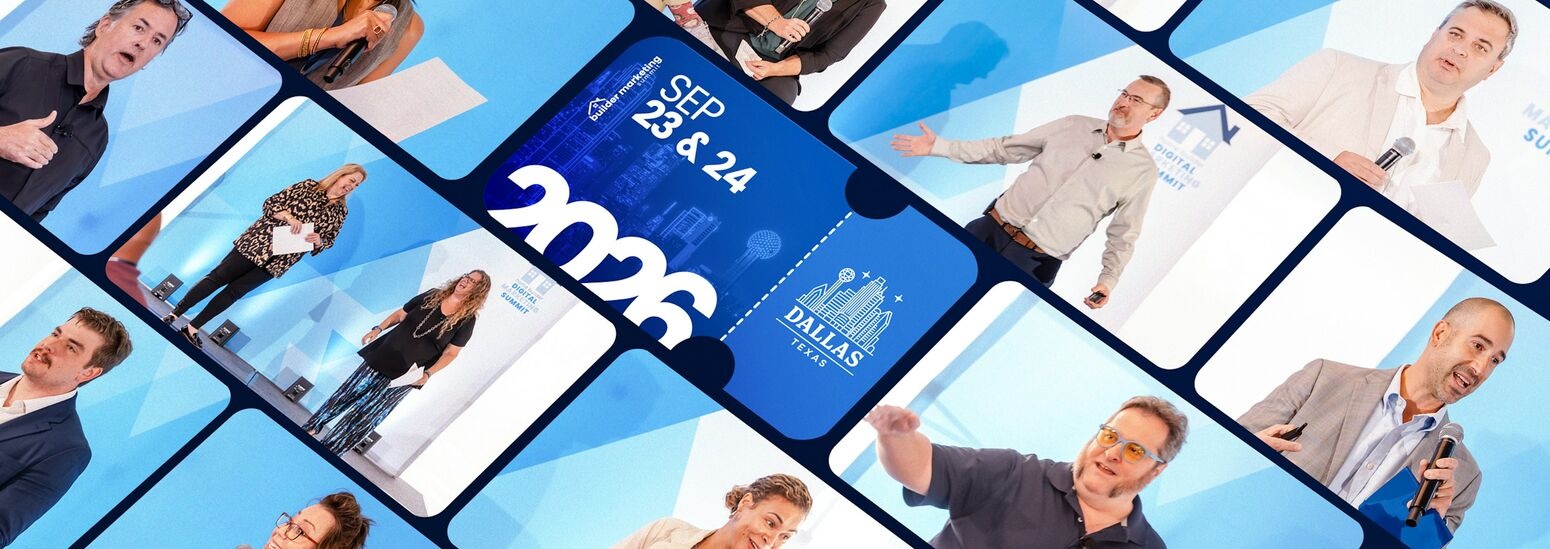
We came home from the Builder Marketing Summit hosted by Blue Tangerine and Outhouse with plenty of notes, new ideas, and conversations we’re still thinking about.
A few themes kept coming up, from how builders experiment with new ideas, to where they’re reaching buyers, to what happens after a prospect finally raises their hand.
Here are five things that stuck with us.
1. “If it helps sell one more home…” try it.
One of our favorite ideas from Bloomfield Homes was also one of the simplest:
“If it helps sell one more home…”
The idea is to give your team permission to try something new. Test it. Evaluate it. See what happens.
Not every new channel, technology, or creative idea needs a perfect business case before it gets a chance to prove itself. Sometimes the potential to sell one more home is enough reason to experiment, as long as you’re willing to measure what happens next.
For an industry navigating a changing buyer, new technology, and no shortage of new marketing tactics, that mindset stuck with us.
2. Your website shouldn’t be an afterthought.
At the Builder Marketing Summit, "afterthought" had a practical meaning.
When inventory, pricing, availability, or other core information changes, how many places does your team have to update? If the change is made in one system but someone must then spend hours bringing the website and other channels back into sync, the website has become an afterthought in the workflow.
The better model is a connected source of truth: update the information once and let it flow everywhere buyers encounter it.
That matters because buyers rely on your website to explore communities, compare homes, confirm availability, and validate information they may have seen elsewhere. When those details don’t match, confidence can erode quickly. Our pre-Summit mystery shopping surfaced a separate, but related, website issue. We reviewed the digital buyer journeys of 44 participating builders and found that more than 70% of the builder webforms raised potential concerns related to TCPA consent requirements.
The Telephone Consumer Protection Act (TCPA) and related Federal Communications Commission (FCC) rules govern certain types of calls and texts to consumers, including when those outreaches can be made. Other requirements include giving consumers a way to revoke consent and opt out of future communications.
Certain states impose stricter requirements on how and when a business can call or text. It is important to know the exact rules in each of the states you do business in. One size does not fit all.
That means the customer experience isn't only about how easy it is to opt in. Builders also need to think about what happens when a prospect no longer wants to hear from them. Depending on the communication, businesses may need to recognize and honor reasonable opt-out requests, including common responses such as “stop,” “quit,” “end,” “revoke,” “opt out,” or “unsubscribe.”
And the potential consequences make TCPA compliance more than a technicality. The TCPA provides a private right of action with statutory damages of $500 per violation, which a court can increase to as much as $1,500 per violation for willful or knowing violations. At scale, repeated communications can create meaningful legal and financial exposure.
We're digging further into what our mystery-shop findings mean in practice, and we're not making a legal determination about any individual builder's compliance. But the over 70% finding reinforced an important point:
The digital buyer journey isn't only about making it easy for someone to start a conversation. It's also about respecting their ability to end one.
3. Your competition isn't just the builder down the street.
A new construction buyer isn't necessarily deciding between Builder A and Builder B. They're comparing all homes available to them, and that means new construction is competing with resale inventory too.
That raises a different question for builders: Where are buyers looking at all their options, and are your homes showing up there?
The lesson for us was simple:
Don't show up only where other builders are. Show up where your buyers are comparing their options.
4. Buyers are making up their minds before they search. Meet them earlier.
By the time someone searches for a specific builder or community, they may already have opinions about where they want to live and what belongs on their shortlist.
One of the interesting conversations at the Builder Marketing Summit centered on geofencing, geo-targeting, and programmatic advertising as ways to reach prospective buyers earlier in that process.
Geofencing lets marketers define a virtual boundary around a physical location and, depending on the platform and available location permissions and data, reach mobile devices associated with people who enter that area. For builders, that could mean reaching potential buyers who visit apartment communities, competing communities, employers, retail destinations, or other locations that may signal future homebuying intent.
Instead of waiting for someone to demonstrate explicit search intent, the idea is to identify signals that may come before the search and use them to introduce your brand or community earlier.
The takeaway wasn't simply “do more geofencing.” It was to rethink when marketing starts.
If buyers are forming preferences before they actively search, how can you become part of their consideration set earlier?
Which brings us to another takeaway from the Builder Marketing Summit that was almost comically at odds with this one.
5. Buyers are searching before they're ready to buy. Keep engaging them.
First, we heard that builders should reach buyers before they search. Then, we heard that even after buyers search, browse your website, and submit a form, they still may not be ready to buy.
So the assignment for builder marketers is apparently simple: Get there earlier. Then be prepared to wait longer.
It sounds contradictory, but it reflects how people actually buy homes. Someone can be genuinely interested without being ready to make a decision today, especially in today’s market. They may be watching interest rates, working through financing, waiting for a lease to end, selling another home, or simply trying to feel confident about what comes next.
And readiness can change quickly. Freddie Mac reported that the average 30-year mortgage rate rose from 7.03% to 7.28% in a single week. When affordability can shift that fast, a buyer who pauses may not have lost interest. They may simply be recalculating what’s possible.
That's why generating the lead is only the beginning.
Our mystery shopping continues to show a meaningful difference between following up once and maintaining engagement. Some builders make an initial outreach attempt and then disappear — what we call a “one-hit wonder.” Others continue the conversation across channels and over time.
And one reaction we heard when builders saw their mystery-shop results made us laugh:
“Okay, but was anyone worse than us?”
It's a natural question. Everyone wants the benchmark. But perhaps the more useful question is:
What would have happened if this had been a real buyer?
Did one unanswered phone call end the follow-up? Of the builders that called during our mystery shop, 26% didn’t leave a voicemail. From the sales team’s perspective, an outreach attempt was made. But from the buyer’s perspective, how would they know who was calling, or why? Was there another text, email, or attempt to reconnect later?
The answer isn’t to pressure buyers into moving before they’re ready. It’s to maintain the relationship in a helpful, low-pressure way so that when their circumstances change, the conversation doesn’t have to start over.
The opportunity is to stay relevant through the space between “I'm interested” and “I'm ready.”
The buyer journey is bigger than the lead.
Taken together, #4 and #5 left us with perhaps our biggest takeaway from the Builder Marketing Summit:
The buyer journey is getting longer in both directions.
Buyers are forming opinions before they actively search. And they're researching and engaging before they're ready to make a decision. That means builder marketing can't only optimize for the moment someone becomes a lead.
There are opportunities to show up earlier, stay engaged longer, and make every moment in between count.
And maybe that's where the “one more home” rule comes back in.
Try something. Measure it. Learn from it.
Then keep what works.
Ready to make more of the leads you’re already generating?
Lumin.ai uses automated, two-way texting to engage leads quickly, keep the conversation going, and turn more buyer interest into qualified appointments.